2013 - Bill Culbert
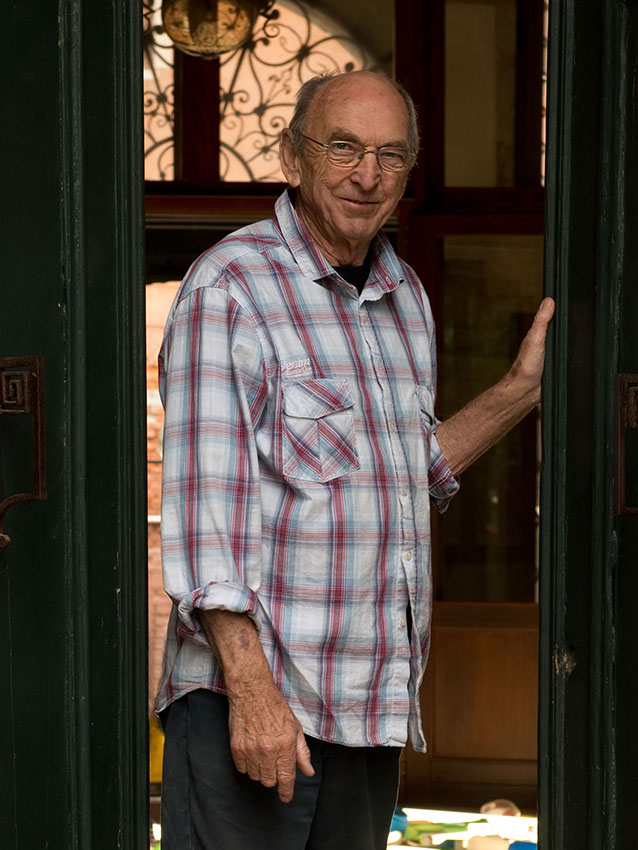
Bill Culbert, 2013. Photo: Jennifer French.
Core Team Members
Commissioner: Jenny Harper
Deputy Commissioner: Heather Galbraith
Curator: Justin Paton
Project Director: Jude Chambers
Exhibition Attendants
Amber Baldock, Sean Duxfield, Lauren Gutsell, Jamie Hanton, Anne Harlow, Marlaina Key, Angela Lyon, Gina Matchitt, Pippa Milne, Hutch Wilco
Project Publication Bill Culbert: Front Door Out Back
Editor: Heather Galbraith
Contributing Writers: Justin Paton, Ian Wedde, Yves Abrioux, Andrew Wilson
Designer: Anna Brown
Publisher: Christchurch Art Gallery Te Puna o Waiwhetu, in partnership with Creative New Zealand and Massey University.
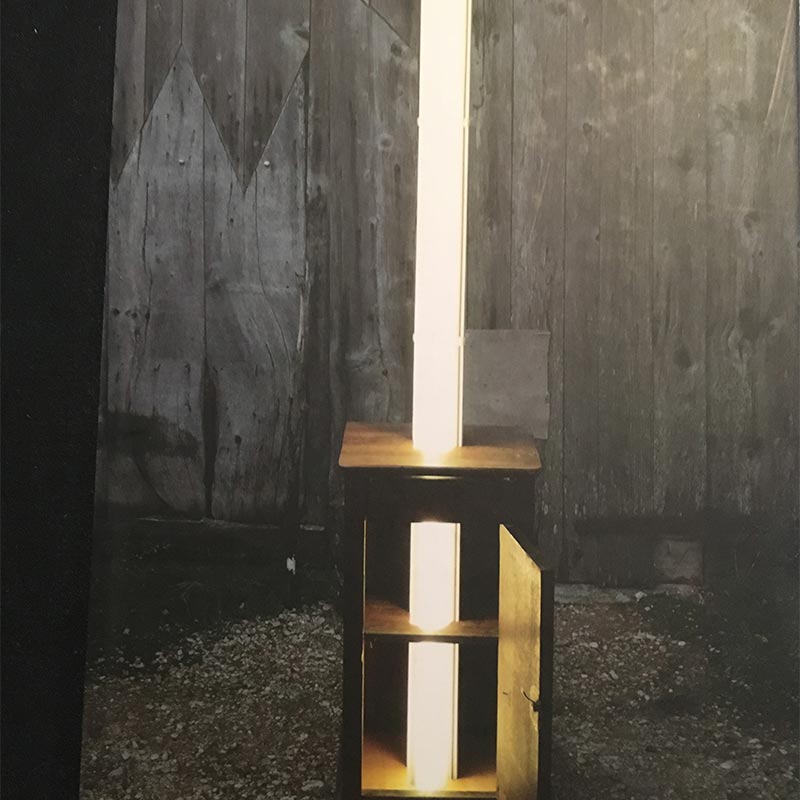
At the Biennale Arte 2013 Bill Culbert’s exhibition, Front Door Out Back, featured nine installations using fluorescent lights and recycled domestic objects.
Front Door Out Back occupied various exhibition spaces in the historic Instituto Santa Maria della Pietà (La Pietà) including an outdoor courtyard and a corridor where Vivaldi once taught violin.
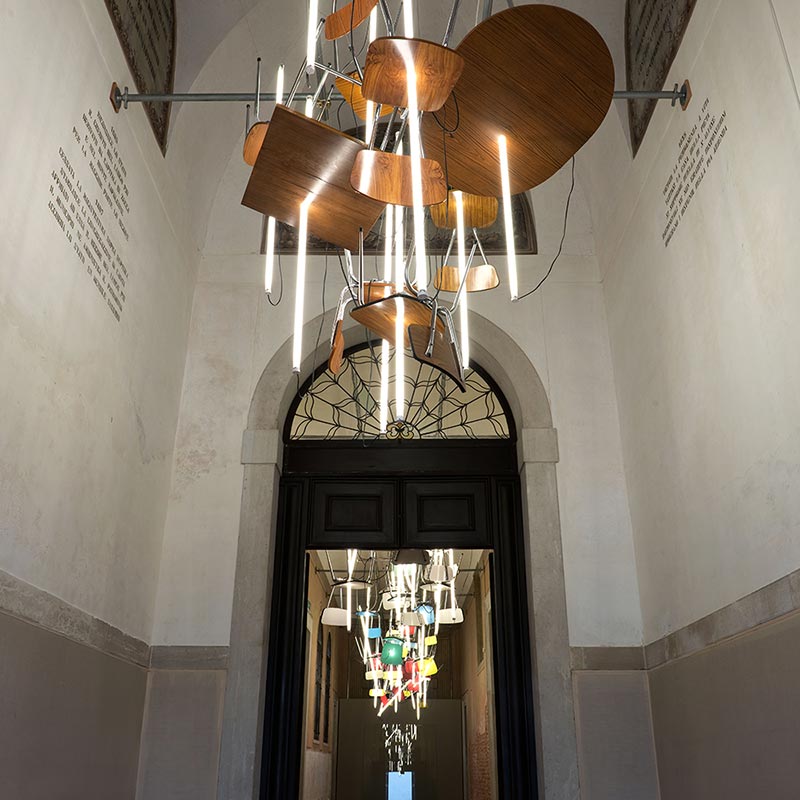
On arrival visitors encountered Bebop, a 15-metre-long work suspended from the ceiling of the historic corridor, where 34 second-hand tables and chairs seemed to have been lifted and spun through the space, each one pierced by a single bolt of fluorescent light.
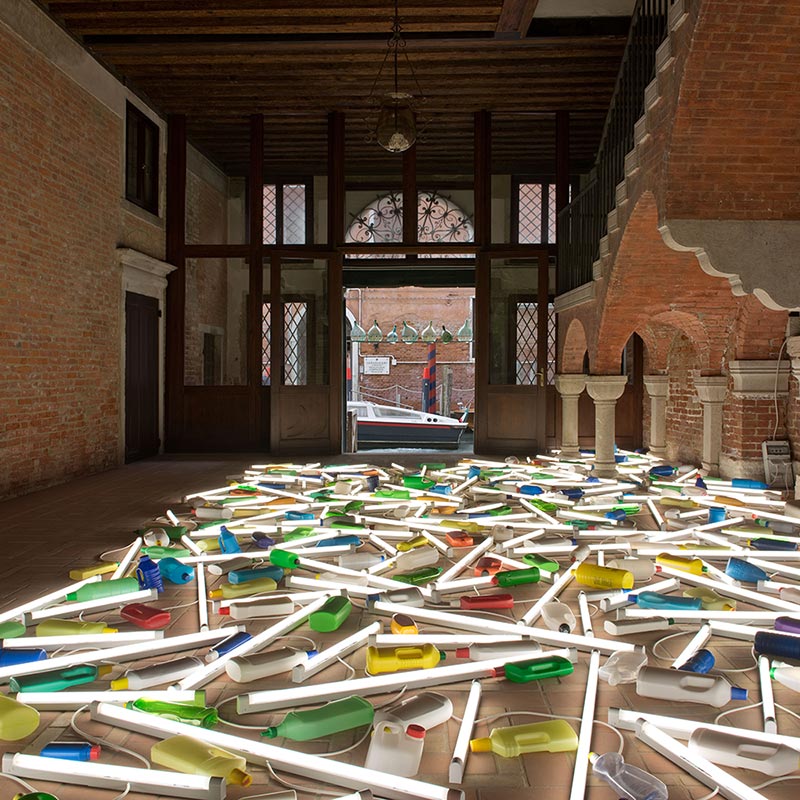
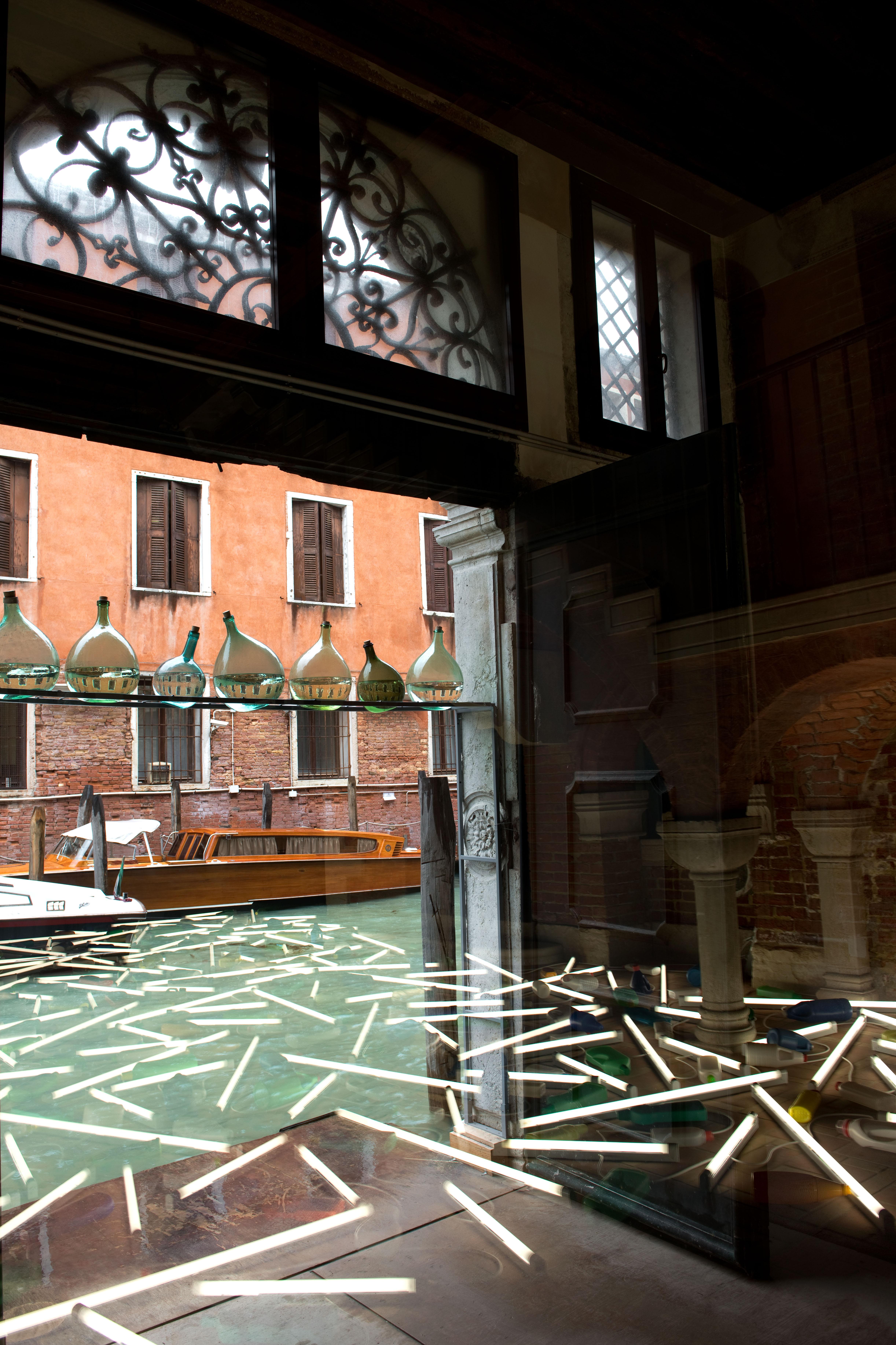
In another work, Daylight Flotsam Venice, Culbert fed 150 fluorescent tubes into a densely packed field of recycled plastic bottles creating a carpet of colour, seen against the backdrop of the canal beyond.
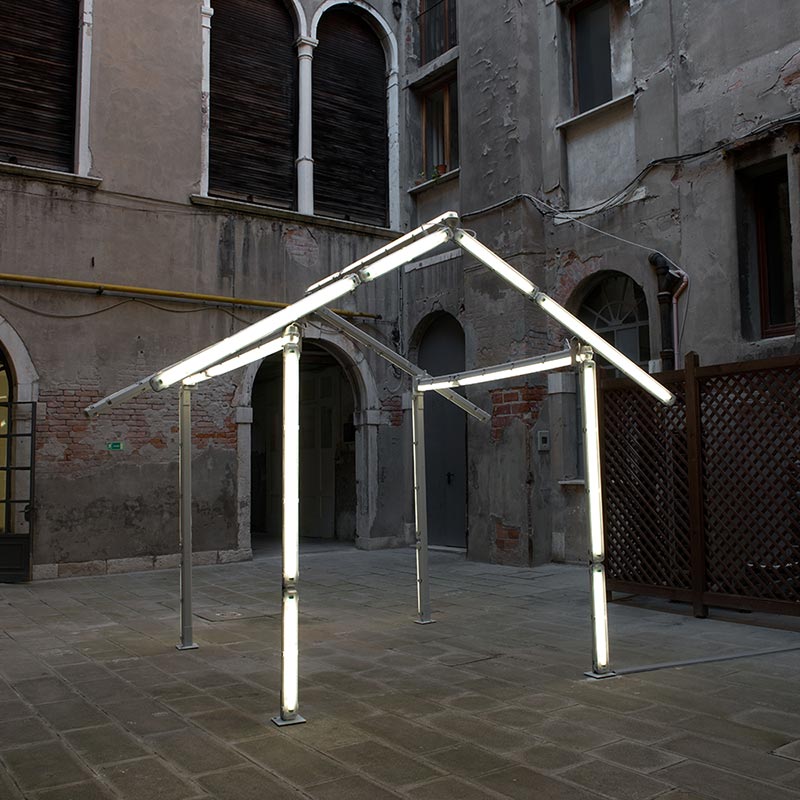
the nine installations included 10 works which were Bebop; Drop; Two Drop; Daylight Flotsam Venice; HUT, Made in Christchurch; Level; Strait; Walk Blue; Walk Reflection and Where are the other two?
Daylight Flotsam Venice and Drop were purchased by the Museum of New Zealand Te Papa Tongarewa, for the national collection while Bebop was purchased by Christchurch Art Gallery Te Puna o Waiwhetu.
In 2015, selected works from Front Door Out Back were exhibited in the National Art School Gallery, Sydney.
More on the artist
Bill Culbert, born in 1935, is a pioneer of the use of electric light in art, making works that harness the qualities of this intangible medium from as early as the 1960s. Over a career spanning almost six decades and more than 100 solo exhibitions throughout New Zealand, England, Europe, the United States and Australia he has pushed the frontiers of art through a rigorous, inventive and economic use of materials.
Light is both medium and subject matter in his sculptures, installations and photographs. It is also the means of mounting a philosophical enquiry into the art object and its materiality. Culbert's sculptural installations make striking use of found and new materials, illuminating the qualities of common things and their surrounding environments.
Culbert's extraordinarily diverse career relates to many different aspects of contemporary art, among them constructivism, op art, kinetic art and conceptualism. His importance is indicated by his participation in a number of major group exhibitions, including a survey of British and Brazilian Concrete Artists at the Centro Brasileiro Britânico in São Paulo, Brazil (2012): the Op Art exhibition at the Schirn Kunsthalle in Frankfurt, Germany in 1997; Un siècle de Sculpture Anglaise, at Jeu de Paume in Paris (1996); and the Sixties Art Scene at The Barbican, London (1993).
Culbert’s work is owned by numerous public and private collections around the world. He has permanent commissioned sculptures in London, Wellington and Auckland. Many are collaborative works with Ralph Hotere, including Fault on the facade of City Gallery Wellington (1994), Void (2006) in the atrium of Museum of New Zealand Te Papa Tongarewa and Black Stump, a 20m-high column outside the Vero Centre in Auckland. His work is held in public and private collections throughout New Zealand and Europe.
He was born in Port Chalmers, near Dunedin and now divides his time between Provence, France and London, England.